
Heavy rainfall in the Miami Valley often brings a hidden sense of worry for homeowners with basements in Kettering, Centerville, and surrounding areas. A severe storm should not mean staying awake at night wondering if your basement floor drains are about to back up. This guide shows how you can secure your home against wet-weather sewer issues using available county financial assistance.
 How Clean Water Connections Create a Sewer Crisis
Many homeowners believe that all household drains lead to the exact same place and handle water the same way. It is common to think that routing rainwater from a foundation drain or a sump pump directly into your home's sanitary sewer line is a perfectly fine setup. In reality, sending clean rainwater into the sanitary sewer system creates a major operational problem for our local infrastructure.
Disconnecting clean rainwater sources from the sanitary sewer line keeps the neighborhood system from overloading and qualifies property owners for county financial aid.
Sanitary sewers are strictly designed to carry away wastewater from toilets, sinks, and showers. When older homes—especially those built before the Clean Water Act of 1972—route heavy storm runoff from foundation drains into the sanitary line, the system quickly overloads during a heavy storm. This excess water causes the main neighborhood sewer lines to fill up completely, pushing wastewater backward into local basements.
 The Expensive Surprise of an Overloaded System
Ignoring a clean water connection might seem harmless right now, but it leaves your home vulnerable to severe property damage. Six months from now, a single intense afternoon downpour can overload the local sewer mains. When the street sewers fill to maximum capacity, the excess water travels along the path of least resistance. This often means sewage backs up through your basement floor drains, ruining your finished spaces, mechanical equipment, and family storage.
Fixing the aftermath of a sewer backup is incredibly expensive. Beyond the high cost of emergency cleanup, a history of basement flooding can severely hurt your home equity and make your property much harder to sell in the future.
The main contact for the program is Chris Claywell, a planner scheduler for Montgomery County Environmental Services, who can be reached at his Kettering office at 937-781-2549 to help guide you through the funding process.
How the Foundation Drain Disconnect Program Protects Your Wallet
To solve this community-wide issue, Montgomery County Environmental Services runs the Foundation Drain Disconnect (FDD) Program. If your home has a below-grade floor and is located in a flood-prone area, the county will help pay to fix your drainage lines.
The financial benefits of this program are substantial:
Sewer Disconnection Funding: The county will pay up to $4,400 per lateral connection to disconnect clean water sources like downspouts, outside stairwells, and foundation drains from the sanitary sewer line.
Sump Pump Assistance: If your basement has bathroom facilities and requires a sump pump installation to route the water outside safely, the county provides an additional amount up to $1,000.
Direct Contractor Payment: You do not have to pay the covered amount out of pocket and wait for a refund. Once the work passes a final county inspection, Montgomery County sends the check directly to your plumbing contractor.
To receive this funding, the county requires you to get quotes from three pre-qualified plumbing contractors. Honey Go Fix It is proud to be an approved, pre-qualified contractor for the Montgomery County FDD program. The county bases its funding approval on the lowest of the three bids, and any costs that go over the approved limit are the homeowner's responsibility.
Immediate Checklist for Montgomery County Homeowners
While large-scale drainage changes must be handled by an approved professional, you can check a few areas around your property today:
Trace Your Sump Pump Line: Locate your basement sump pump and follow the discharge pipe. If the pipe runs directly into a wall or a floor drain instead of running outside to your lawn, it is likely tied illegally to the sanitary sewer.
Check Outside Stairwells: Look at the drain at the bottom of your outdoor basement steps. If water clears slowly during a storm or smells like sewer gas, it may be tied directly into your home's main wastewater line.
Inspect Your Gutter Downspouts: Make sure your downspouts empty onto the ground at least three feet away from your foundation rather than disappearing into clay tile pipes in the earth.
Why This Program Requires a Qualified Professional
The FDD program completely bars homeowners from pulling their own permits for this work. The county requires a licensed plumbing contractor to manage the entire process, pull the necessary plumbing permits, and schedule official inspections.
The process also involves a highly technical step: an under-house pressure test. Code enforcement requires us to perform a pressure test on the sanitary service pipes beneath your basement floor to ensure there are no hidden leaks. The cost of this initial test is fully covered by the FDD program. However, it is important to know that if the test finds a leak in your underground pipes, the cost to locate and repair that specific leak is not covered by the county and remains the homeowner's responsibility.
Navigating the County Approval Process
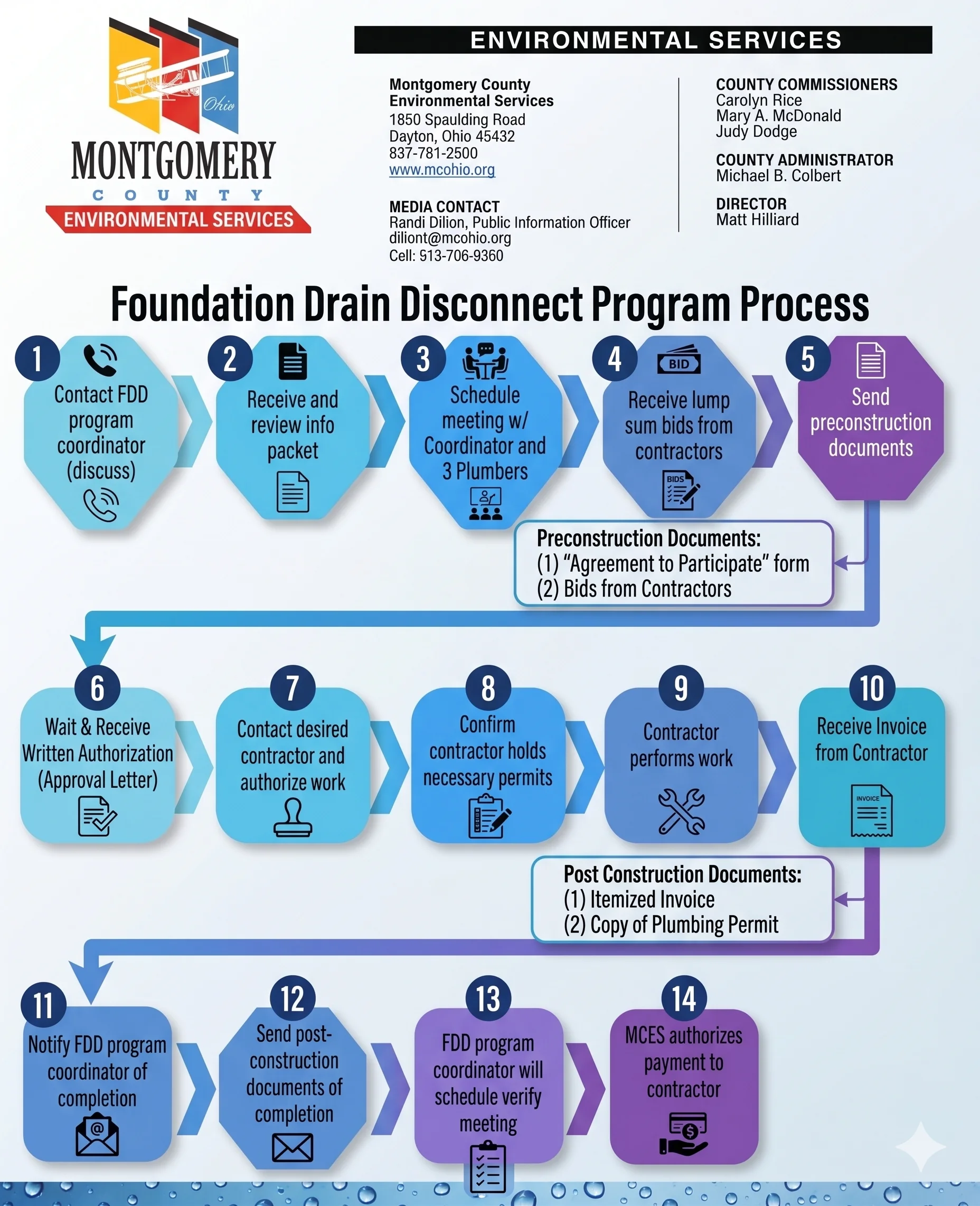
Getting your project funded requires following a specific sequence of steps laid out by the county FDD coordinator, Chris Claywell. First, you must contact the county to receive an official information packet. Next, you will schedule a joint meeting at your home with the county coordinator and your three chosen pre-qualified contractors to evaluate the work together.
After collecting the bids, you sign the county's "Agreement to Participate" form and mail the paperwork to the county office at 1850 Spaulding Road. You must wait until you receive an official "Participation Approval" letter in writing before authorizing any work to start. The county will not pay for any plumbing work that begins before they give written pre-approval. After the chosen plumber finishes the job, the county coordinator schedules a final home visit to verify that all clean water lines are permanently disconnected before releasing payment to the contractor.
Frequently Asked Questions
Who is eligible to participate in the Montgomery County FDD program? The program is open to any Montgomery County Environmental Services customer who owns a home with a basement or split-level floor design. It is specifically aimed at homes built before 1972 or properties located in areas with a known history of wet-weather sanitary sewer backups.
Who is the program coordinator, and how do I contact them to get started? The main contact for the application process is Chris Claywell, the Planner Scheduler for Montgomery County Environmental Services. His office is located at 1850 Spaulding Rd, Kettering, OH, 45432. You can reach him directly at 937-781-2549 to ask initial eligibility questions, express your interest in participating, or request your official program entry packet.
What is the official step-by-step process for getting these upgrades approved? The county requires a specific sequence of actions to ensure your project qualifies for financial backing. You can review the exact 14-step path in the updated process chart above. The process begins with an informational packet, moves through a joint home meeting with three pre-qualified plumbing contractors, and requires you to receive an official "Participation Approval" letter in writing before any physical work or digging can begin on your property.
What kind of plumbing equipment will be installed in my basement? Depending on your home's layout and plumbing fixtures, a contractor may install a combination of backwater valves, ball shutoff valves, and a dedicated sump pump system to route clean water out to your lawn.
How does the final county approval and payment process work? Once our team finishes the installation, you will submit our itemized invoice and a copy of the completed plumbing permit to the county. A county representative will then visit your home to verify the work meets their strict engineering specs. Once approved, the county sends the check straight to us, and we hand you an Operations and Maintenance Manual so you know how to care for your new system.
Bringing Long-Term Safety to Your Basement
Your home is your most significant investment, and keeping your basement dry is essential to protecting your family's health and property value. The Montgomery County FDD program is an incredible opportunity to upgrade your home's defense system using local financial aid. Our team at Honey Go Fix It is here to walk you through the paperwork, provide a clear quote, and deliver the top-tier service your Dayton home deserves.
Honey Go Fix It provides residential plumbing services for homeowners in Dayton, Beavercreek, Centerville, Springboro, Xenia, and nearby suburbs.