Short answer for Dayton, Beavercreek, Centerville, Springboro, and Xenia homeowners: Yes. A leaking shower arm is usually a failed drop-ear elbow—the fitting inside the wall that the shower arm screws into—and it can very often be reached from the back side of the wall instead of through the tile. On this September 2026 job we opened one access panel in the adjoining closet, replaced the fitting, and had the shower running again the same day, with no tile removed. If your shower head wobbles or you have found a damp spot near the shower wall, call Honey Go Fix It at (937) 777-9626 to schedule an inspection.
Can a leaking shower be fixed without tearing out the tile?
Yes, if there is a wall, closet, or cabinet backing onto the shower valve. Tile is the expensive part of a bathroom and the part nobody can match years later, so the first question we ask on a shower leak is not “how do we get through the tile” but “what is on the other side of this wall?” In a lot of Greater Dayton homes the answer is a bedroom closet, and that turns a tile demolition into a patch of drywall and an afternoon of paint.
It is not always possible. If the leak is at the valve body or the shower pan, or if the far side is an exterior wall, the tile side may be the only way in. But it is worth checking before anyone picks up a grinder.
What was going wrong in this home?
In September 2026, a homeowner called us about his shower. The shower head had started to move when he adjusted it, and he was seeing moisture where the wall met the floor. He needed it handled quickly—he had a hard deadline that week and could not leave a shower out of service.
A shower arm that moves is not a cosmetic complaint. It is the single most reliable early warning that the fitting behind it has come loose, and it is the point where a small drip becomes a wet wall cavity.
What did we find?
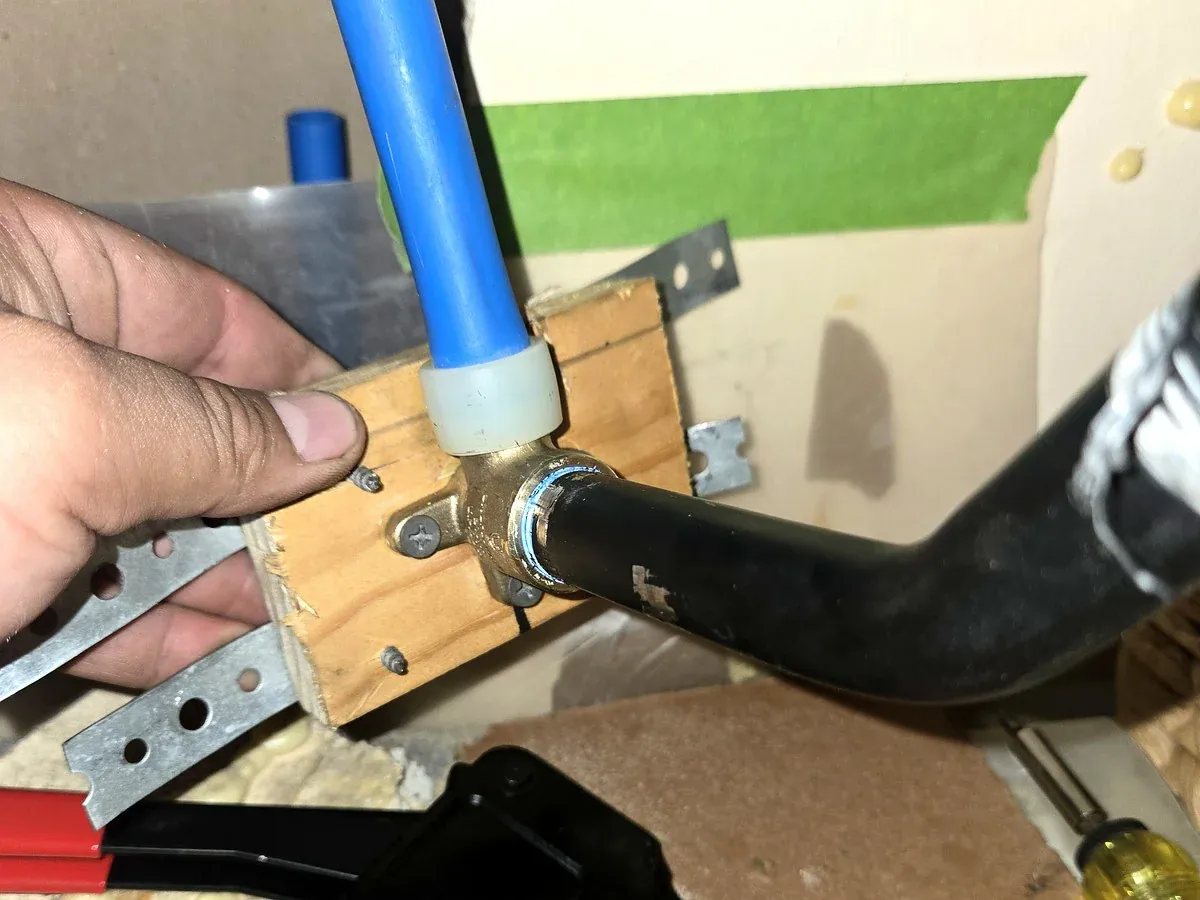
Our technician traced it to the drop-ear elbow. A drop-ear elbow is a brass fitting with two flanged “ears” that screw into a wood backer inside the wall. That backer is what holds the fitting still. Every time you tighten a shower arm, or hang a caddy on it, or knock it with your elbow, the load goes into those two screws.
On this house the backer had given up. The fitting was moving with the shower arm, and that movement had worked the threaded joint loose enough to weep into the wall cavity. The fitting itself was serviceable, but reinstalling it on the same tired backing would have put us back in the same bathroom within a year.
The bathroom wall was fully tiled. The closet on the other side was painted drywall.
How did we repair the drop-ear elbow?
We worked from the closet, not the bathroom.
- Opened one access panel. Our technician cut a single rectangular opening in the closet drywall, sized to reach the fitting and no larger.
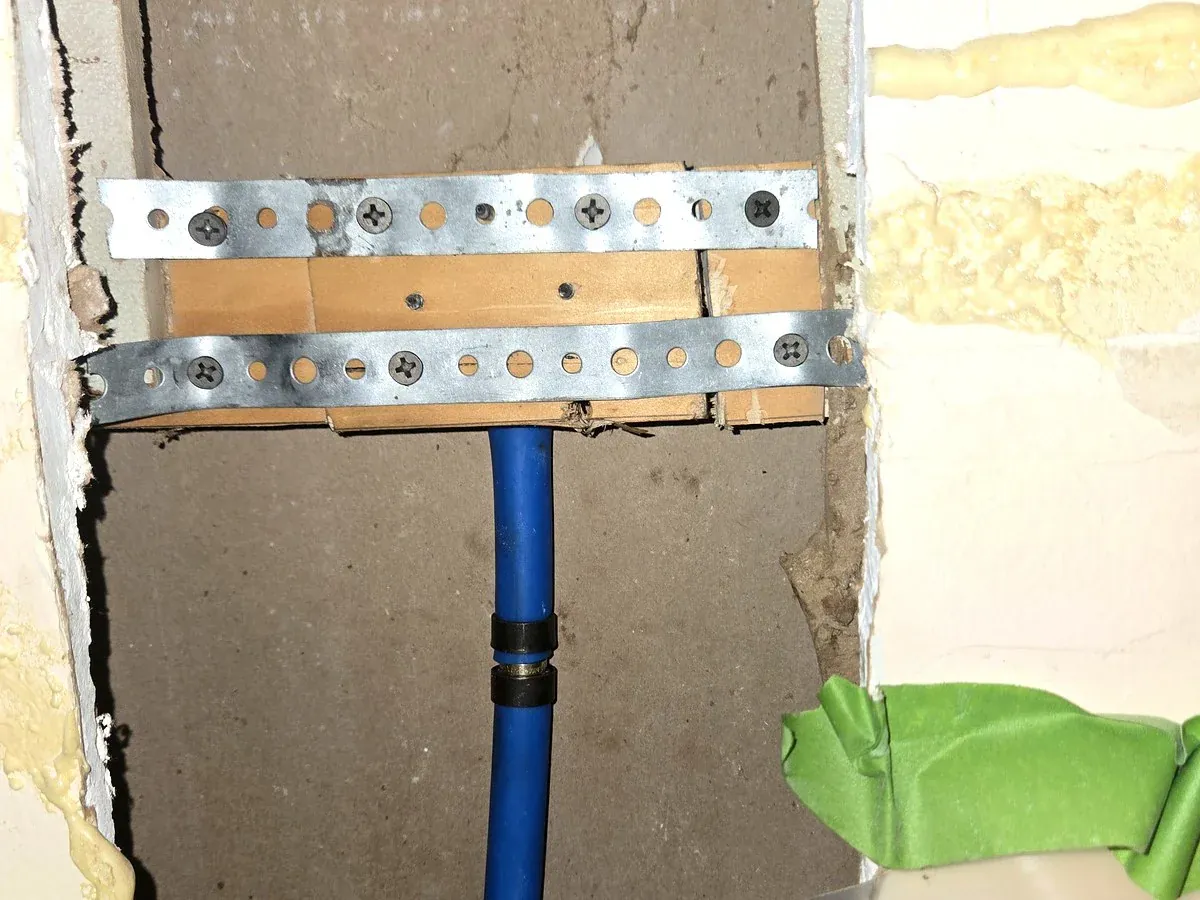
- Fitted a new wood backer. A fresh board was cut and set between the studs to give the elbow something solid to land on.
- Installed a new brass drop-ear elbow. The new fitting was screwed flat to the backer through both ears.
- Anchored the assembly to the framing. Galvanized strapping was run across the backer and screwed into the studs on both sides, so the fitting carries its load into the frame instead of into two screws in a board.
- Reconnected the PEX supply and made up the joint to the new elbow.
The order matters. The anchoring is the actual repair. Swapping the elbow without fixing what it mounts to is the version of this job that fails again.
How do you know the leak is actually fixed?
We do not close a wall on an untested joint. With the access panel still open, we brought the water back up and ran the shower while watching the fitting and the cavity below it directly. The connection stayed dry under pressure, and the shower arm no longer moved when it was handled.
Only then did we hand the shower back. The homeowner had it in service the same day, and the only finish work left behind was one drywall patch in a closet—a patch to paint, and not a single tile to match.
The homeowner left us a five-star review afterwards:
“Wasted no time in getting our issue fixed.”
The repair is backed by our parts and labor warranty.
Questions we get about shower leaks
My shower head wobbles when I turn it. Is that a problem in my Kettering home?
Treat it as one. A shower arm should not move at all. Movement means the drop-ear elbow behind it is no longer held still, and that is the condition that works the joint loose and starts a leak inside the wall. It is a cheap thing to look at now and an expensive one to ignore.
Can you always avoid removing tile in a Beavercreek bathroom?
Not always, but more often than homeowners expect. It depends on what backs onto the shower wall and where exactly the leak is. We check the far side first and tell you what is possible before any cutting starts.
How do I know if water is leaking inside the wall in my Centerville home?
Look for the quiet signs rather than a puddle: a musty smell in the bathroom or the room behind it, paint or baseboard that has started to lift, a soft spot in the drywall, or a stain on a ceiling below. Water inside a wall almost never appears where it enters.
What does a shower drop-ear repair cost in Xenia?
It depends on how the wall is built and how the fitting has to be reached, so we quote the specific job before we start rather than publishing a number that will not match your bathroom. You get the price before any work begins, and we show you what we found.
Honey Go Fix It provides residential plumbing services for homeowners in Dayton, Beavercreek, Centerville, Springboro, Xenia, and nearby suburbs. Call (937) 777-9626 to schedule an inspection.